
TIGER
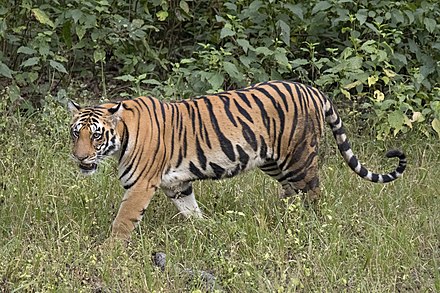
The tiger (Panthera tigris) is the largest living cat species and a member of the genus Panthera. It is most recognisable for its dark vertical stripes on orange-brown fur with a lighter underside. It is an apex predator, primarily preying on ungulates such as deer and wild boar. It is territorial and generally a solitary but social predator, requiring large contiguous areas of habitat, which support its requirements for prey and rearing of its offspring. Tiger cubs stay with their mother for about two years, before they become independent and leave their mother's home range to establish their own.
The tiger once ranged widely from the Eastern Anatolia Region in the west to the Amur River basin in the east, and in the south from the foothills of the Himalayas to Bali in the Sunda Islands. Since the early 20th century, tiger populations have lost at least 93% of their historic range and have been extirpated from Western and Central Asia, the islands of Java and Bali, and in large areas of Southeast and South Asia and China. Today, the tiger's range is fragmented, stretching from Siberian temperate forests to subtropical and tropical forests on the Indian subcontinent and Sumatra.
Generally, males vary in total length from 250 to 390 cm (8.2 to 12.8 ft) and weigh between 90 and 300 kg (200 and 660 lb) with skull length ranging from 316 to 383 mm (12.4 to 15.1 in). Females vary in total length from 200 to 275 cm (6.56 to 9.02 ft), weigh 65 to 167 kg (143 to 368 lb) with skull length ranging from 268 to 318 mm (0.879 to 1.043 ft). In either sex, the tail represents about 0.6 to 1.1 m (24 to 43 in) of the total length. The Bengal and Siberian tigers are amongst the tallest cats in shoulder height. They are also ranked among the biggest cats that have ever existed reaching weights of more than 300 kg (660 lb). The tigers of the Sunda islands are smaller and less heavy than tigers in mainland Asia, rarely exceeding 142 kg (313 lb) in weight.
WHERE WILL YOU FIND THEM
You will find the tigers at pen H22.